Mood swings, energy dips, and sudden cravings aren't random — they follow a predictable hormonal rhythm that repeats every cycle, once you know the four phases behind it.
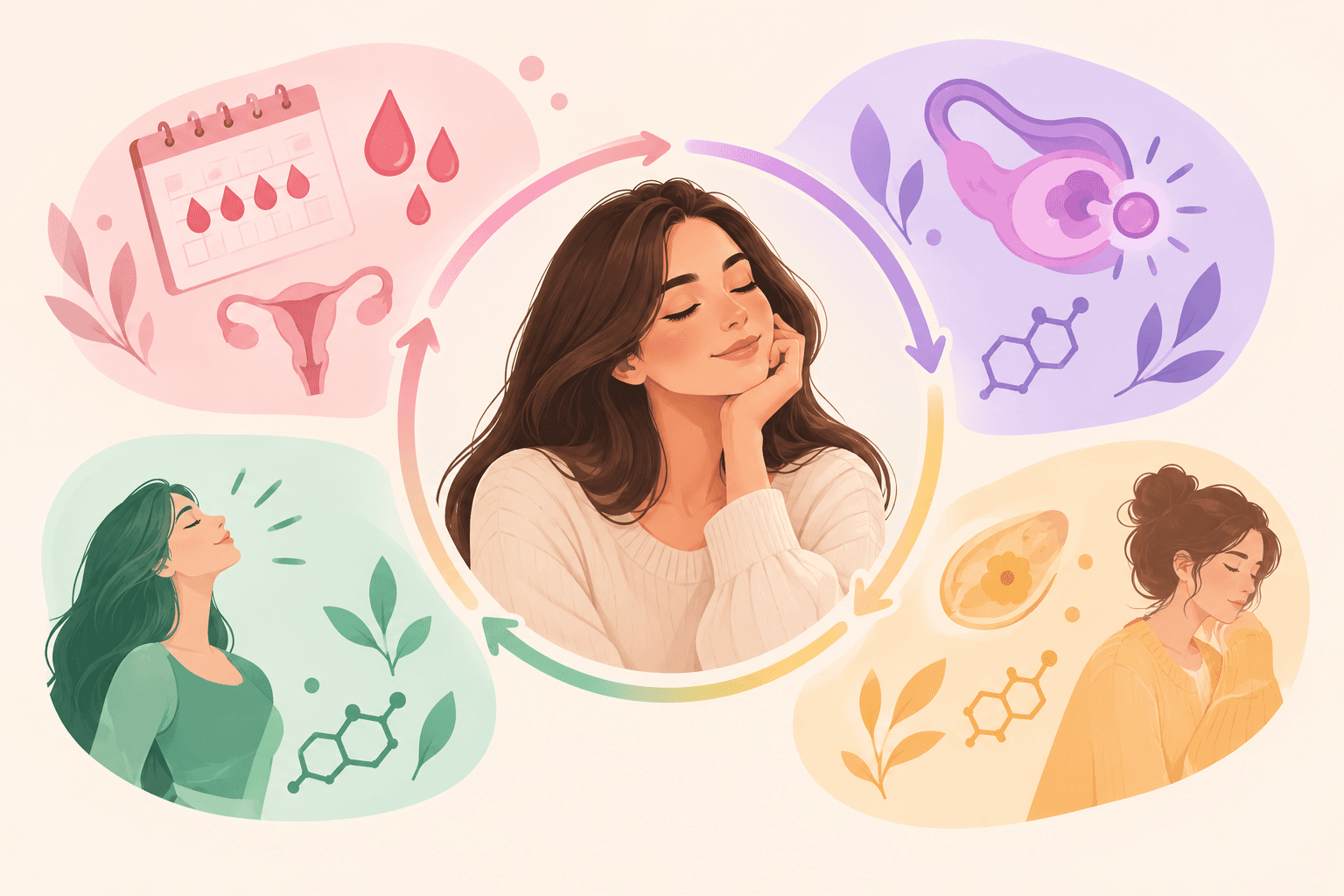
The menstrual cycle is often reduced to little more than the days you bleed, but bleeding is just one visible part of a much longer, four-phase process that repeats roughly every month. Understanding what is happening hormonally in each phase can make sense of mood swings, energy changes, and appetite shifts that otherwise feel random.
The cycle begins with the menstrual phase, day one being the first day of bleeding. At this point, levels of estrogen and progesterone are at their lowest, which is actually part of what triggers the shedding of the uterine lining. Low hormone levels can also explain why some people feel more tired, low-energy, or emotionally flat during these first few days. It is a natural low point, not a sign that something is wrong.
As bleeding tapers off, the body moves into the follicular phase, which technically overlaps with the start of menstruation and continues until ovulation. During this phase, the brain signals the ovaries to prepare an egg, and estrogen begins a steady climb. Rising estrogen is linked to gradually improving energy, sharper focus, and a more upbeat mood for many people. This is often the stretch of the cycle where exercise feels easier and motivation is naturally higher, simply because the hormonal environment supports it.
Around the midpoint of the cycle comes ovulation, triggered by a surge in luteinizing hormone that causes the ovary to release an egg. Estrogen typically peaks just before this surge, and many people notice this as a time of heightened confidence, sociability, and physical energy. It is also the window during which pregnancy is possible, since the released egg can be fertilized for a short period. Some people notice a brief twinge of discomfort on one side of the lower abdomen around ovulation, and changes in cervical mucus, which becomes clearer and stretchier, are a normal accompanying sign.
After ovulation, the luteal phase begins and lasts until the next period starts. The ruptured follicle that released the egg transforms into a temporary structure that produces progesterone, which rises to prepare the uterine lining in case of pregnancy. Progesterone has a calming, sometimes sedating effect, which is part of why energy can dip again in the days before a period. If pregnancy does not occur, both estrogen and progesterone drop sharply in the final days of this phase, and this hormonal fall is strongly linked to the mood changes, irritability, bloating, breast tenderness, and food cravings many people recognize as premenstrual symptoms.
None of these shifts mean the body is malfunctioning. They are the expected result of a finely tuned hormonal sequence that has a clear biological purpose: preparing for the possibility of pregnancy each cycle, whether or not that is something a person wants at any given time. Two people can have entirely different experiences of the same phase, and that variation is normal too — hormone sensitivity, stress levels, sleep, and overall health all influence how strongly these shifts are felt.
Paying attention to which phase tends to bring more energy, more appetite, or more emotional sensitivity can be genuinely useful. It allows for planning demanding tasks or workouts around the times energy is naturally higher, and being gentler with expectations during the days energy tends to dip. A simple habit of noting the day of the cycle alongside mood, energy, and any physical symptoms — whether on paper or through a tracking app — often reveals a pattern within just a couple of cycles. That pattern is not a diagnosis and does not need fixing; it is simply useful self-knowledge that turns what can feel like unpredictability into something familiar and expected.
Discussion
0